Keep water withdrawal consumption and discharge distinct

Label each water quantity by what it measures before putting it in a report. Water entering a facility, water released from it and water consumed over the period are different measures. Internal reuse is another flow, and a bill labelled “consumption” may simply record purchased water.
This guide is for reporting teams translating water records into clearly defined metrics. It uses GRI 303 as the reporting reference. Confirm the framework, organisational boundary and period required for your own disclosure; a customer's spreadsheet or another reporting regime may use different instructions.
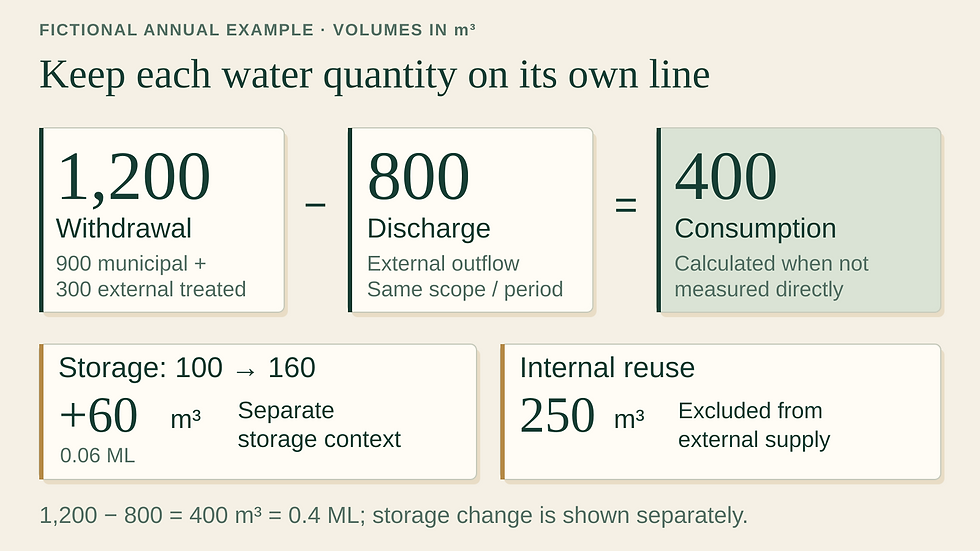
Fictional annual figures: 900 m³ municipal supply + 300 m³ externally supplied treated water = 1,200 m³ withdrawal. With 800 m³ external discharge, calculated consumption is 400 m³ (0.4 ML) where not directly measured. Storage increases from 100 to 160 m³, or +60 m³ (0.06 ML), and is shown separately; it is neither added to nor subtracted from the stated 400 m³ consumption. The 250 m³ internal reuse loop is not additional external supply. These quantities do not by themselves constitute a physical balance or establish leakage, water quality or compliance.
Ask three questions of each record
Where did the water enter? Under GRI 303, withdrawal covers water drawn from the specified environmental and third-party sources during the period. A utility bill can support one supply route; it does not establish the whole organisation's total.
Where did it leave? Discharge concerns water released to an environmental destination or a third party for which the organisation has no further use. Treatment inside the boundary and return to another process is not, by itself, an external discharge.
What remains consumed for the reporting period? GRI's consumption concept includes water not released back during that period, including water stored for later use or discharge. These definitions are set out in the GRI 303 glossary. Apply them consistently rather than relying on the name of an invoice or meter.
Write a metric map before calculating
Use one line per record with the site, source/destination, period, unit, measurement point, proposed metric and supporting document. Add a field for boundary transfers so reviewers can see internal flows and avoid counting them twice.
A municipal meter usually supports third-party withdrawal for the area it actually covers.
A delivery of treated water from an outside supplier is still an external input; “recycled” in the product description does not remove it from withdrawal.
A return loop from on-site treatment to a process belongs in the internal-flow record while it stays inside the reporting boundary.
A sewer or other discharge record needs its own dates, destination and quantity basis. A sewer charge alone may not be a measured outflow.
Tank readings describe stock at a time, not a flow over the month.
These examples are a sorting aid. Check the actual arrangement before assigning the reporting line, particularly for shared estates, third-party treatment, transfers between group sites and water embedded in products.
A fictional facility reporting example
Suppose a facility's checked annual records show 900 cubic metres of municipal supply and 300 cubic metres of externally supplied treated water. External discharge is 800 cubic metres. Another 250 cubic metres passes through an internal reuse loop. Opening storage is 100 cubic metres and closing storage is 160. The scenario and all quantities are invented.
The supported external withdrawal total is 900 + 300 = 1,200 cubic metres. The reuse loop does not increase that total to 1,450. The reported discharge input is 800 cubic metres, assuming its boundary and period have been checked.
Where consumption cannot be measured directly, GRI 303-5 guidance permits calculation as withdrawal minus discharge. On that basis, consumption is 1,200 − 800 = 400 cubic metres. Storage increased by 160 − 100 = 60 cubic metres; GRI requires storage-change disclosure where storage has a significant water-related impact.
For presentation in megalitres, divide cubic metres by 1,000: withdrawal 1.2 ML, discharge 0.8 ML, calculated consumption 0.4 ML and storage increase 0.06 ML. Keep the last figure as context, not an additional consumption amount. Do not subtract it to report 0.34 ML under the stated withdrawal-minus-discharge method.
A physical process investigation can examine where water went, including the storage change. It answers a further question. The reporting calculation alone does not prove that the remaining quantity evaporated, identify leakage or establish the quality of the discharged water.
For that separate preparation task, see the water-balance source-records guide.
Check the boundary when consolidating sites
If one group site sends water to another, identify whether both sit inside the selected reporting boundary. Record the sending and receiving entries as a matched transfer before deciding the consolidated treatment. Otherwise, simply adding site totals can count internal movements as external flows.
Reconcile period dates and measurement coverage first. Do not use a company's corporate discharge total against one plant's withdrawal, or annual withdrawal against nine months of discharge. If a record is missing, identify it and evaluate an explicit estimate under the applicable method; a blank should not silently become zero.
Check what the final sentence claims
Before approving a disclosure, confirm the metric definition, boundary, period, units, measurement or estimation basis and any internal transfers. Check that the narrative says “withdrawal” when the number measures withdrawal, and that reuse is not presented as a verified reduction against an undefined baseline.
Volume data do not establish safe water, permitted abstraction or compliant discharge. Keep permits, quality results and specialist conclusions distinct from the metric calculation.
Nitium's sustainability and GRI reporting support helps organise relevant topics, data, narrative and information gaps. Discuss your water disclosure or email contact@nitium.in with the reporting requirement and records already available.
Reviewed 9 October 2026. This guide explains a reporting preparation task; it is not a complete GRI disclosure checklist, legal opinion or engineering assessment.


Comments